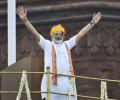
Following is the full text of Prime Minister Narendra Modi's address from the ramparts of the Red Fort on the 73rd Independence Day.

Nitish Kumar and his officials maintain that Bihar has one of the lowest crime rates in India. Bihar police crime data indicates otherwise.

'By the time he came out after nearly five hours, he had a one-to-one conversation with the President, a delegation-level meeting, a reception, a dinner, a tour of the White House and a joint statement of a kind none of his predecessors ever had,' says Ambassador T P Sreenivasan.

Contentious issues such as the construction of a Ram Temple in Ayodhya, abrogation of Art 370 giving special status to Jammu and Kashmir and enactment of Uniform Civil Code have been included in the Bharatiya Janata Party's election manifesto with the party making promises on them.

Business reacted with caution to the reforms of 1991, and demanded protection from multinationals and imports. Twenty-five years later, traces of that demand can still be found, reports Bhupesh Bhandari.

If the aim is to become a player with some strategic space of its own, not just in the Indian Ocean region but also in the adjoining region, then greater interaction with China is desirable, even necessary.
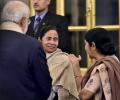
Prime Minister Narendra Modi has positioned himself as a credible partner for Bangladesh. He has scored by getting West Bengal Chief Minister Mamata Banerjee to travel with him to Dhaka, says Srinath Raghavan

Indian economy about to take-off

Moving ahead with their new mantra -- Chalein Saath Saath: Forward Together We Go -- Prime Minister Narendra Modi and United States President Barack Obama on Tuesday vowed to deepen cooperation in every sector for the benefit of global stability and people's livelihoods over the next ten years.

BJP President Amit Shah -- arguably the second most powerful politician in the nation -- granted a rare television interview to the Network 18 group of news channels. Rediff.com's Rajesh Alva checks out what the BJP boss said in this word cloud assessment of the interview.

'The origins of the model of planned economic development adopted by independent India was a direct consequence of the war.' 'The war provided an opportunity for groups at the margins of Indian society to find new avenues for mobility.' 'The war also led to the emergence of India as a major Asian power and set the stage for it to play a wider role in international politics.'

'I ask for bail in the name of justice.' 'Give me a chance to stay alive and see the trial till its end.'
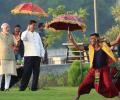
A sensational interview on India-China ties, with the man most qualified to answer.
'They do not want us to construct roads or to conduct health camps. I see no logic in their demands,' says West Bengal Chief Minister Buddhadeb Bhattacharya.

'Patel was more in tune with the popular mood than Jawaharlal Nehru. While the principle that Hindus and Muslims should be able to live together remained central to Nehru's vision for India, the Sardar was less sentimental.' 'Nehru would angrily face down mobs himself, rushing from trouble spot to trouble spot. A veritable tent city, filled with Muslim refugees, sprouted on the lawns of his bungalow... Mountbatten feared Nehru's impulsiveness would get him killed, and assigned soldiers to watch over him.' Nisid Hajari's Midnight's Furies: The Deadly Legacy of India's Partition casts fresh light on the events and personalities behind the horrific division of the subcontinent which haunts the India and Pakistan to this day.

A K Bhattacharya digs into the yet-to-be-public report on ways to curb black money and finds out that Modi's next moves could include action on dabba trading, hawala, and education.
